It has been over a
year
since I purchased the Grizzly Mill and
documented the task of moving it into the basement, getting it set up,
and the few issues I had with getting the mill running in an
acceptable fashion. Well, make that and acceptable fashion for my knowledge at
the time.
During that time, I have had many
email from
folks interested in purchasing a G3101 mill of their own. The
question I'm most
often asked
is "would I do it again?" The answer is both yes and no.
Yes, it has been (and is still) a fun project, an
acceptable product,
and having this mill and getting back into metal-working feels really
good.
However, if you ask me, "Knowing what you know now, would you purchase
another G3103?" The answer is probably no, but not because it
hasn't done
what it was supposed to do. Given its limitations (size and
rigidity), it is an
acceptable product and given its cost, it is a darn attractive
purchase. The reason is two-fold, 1. I have (again) fallen
in love with older machine tools and even
if the Grizzly out-performed an older piece, the satisfaction I get
from bringing an older piece of machinery back to good running
condition and
then using it to make something useful out-weighs a piece that is
already in perfect condition. 2. I am finding that I want to work
on larger pieces than the G3103 will allow. A 50+ inch table
would
be more to my liking and this Grizz is only about 26 inches.
So, what about the mill? What about the
problems I've experienced? What do I think you should
expect if you
buy one of these?
A project. The mill is a project. It isn't quite ready to
make chips when it is unpacked from the crate. If my experiences
and the experiences I have heard about first hand are normal, you
will need to do a bit of work before you can use the mill. How
much work depends on a bit of luck and how accurate you want or need
the mill
to be.
I have had the pleasure to converse with many folks who were
considering a G3103 and a dozen or more folks who have
purchased the G3103 and have kept in touch for, at least, long enough
to get the
mill set up and start making chips. Every one of those people
have had
at least one issue with the mill that needed to be addressed before it
could be used. Most were relatively minor issues, but if you purchase
one of the G3101 mills or their counterparts sold by other retailers,
it would seem that some work is going to be needed before you can start
making chips. Here are some of the issues that I know about
from my mill or from conversations with others with the same mill
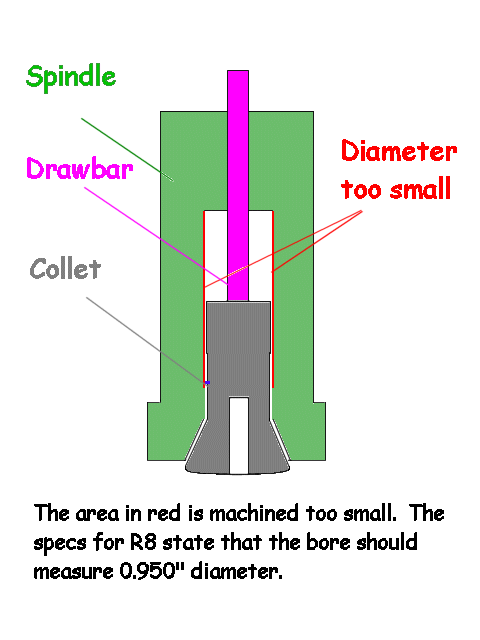
There seems to be a fairly recent batch of Grizzly mills
with
the inside
diameter of the R8 profile in the spindle that have not been bored
large enough to accept anything other than the face mill that is
supplied by the manufacturer
with
the G3103. This is the top of the bore ( the hole - to make it as
clear as
I can), above the locater pin inside the spindle that an R8 shanked
tool would
fit into. This is the area where the draw bar attaches to the
collet or holder. The specs for the R8 are that the
diameter of the hole at the top where the draw bar meets the tool is to
be 0.950 inches. I don't know what the
tolerance is on this, but the second or third to the last person who
experienced
this, figured the hole in his spindle was bored to about 0.948"
or so. He tried honing it out with a two stone
automotive brake hone to no avail, but said that it was a cheap
hone. The stones wore out before he was able to enlarge the
hole. Grizzly customer support recommended either sending the
spindle and quill assembly back to them for resizing or to wrap some
sandpaper around a stick and shove it up into the hole with the mill
running. He opted for the second and while he was able to
increase the diameter enough to get his collets to fit, the locater pin
was sanded down in the process. I would imagine that this will
mean that the quill and spindle is going to make the trip to Grizzly
anyway for a locater pin replacement. On a new mill, I would be
very hesitant to press out the spindle from the quill without having
some replacement bearings handy and this assumes that you have a press
with sufficient force to press the spindle out in the first
place. I guess the end result of this is if you have a Grizzly
mill coming to you, you would be advised to have a couple of R8 collets
or end mill holders to test fit and make sure that your spindle hole
isn't too small.
Other items I have heard of and personally experienced is that the
belts aren't of the best quality. They are made from pretty poor
quality rubber.
They shed rubber dust like crazy and tend to vibrate or maybe pass the
vibrations from the motor to the spindle. A new set of belts will
fix this.
Belt alignment. My idler pulley was aligned to be about half a
belt width too low. A couple of flat washers under the idler
pulley hold-down bolt fixed the issue. You might also take a look
at the motor adjusting mechanism. It is adjusted with a clamp and
pivots on a hinge. My motor was tilted a bit and required a
couple more washers to level it out. I also lock the adjustment,
rather than letting the motor self-adjust
so as not to put full tension on the belts. I find that leaving
the belts a bit on the loose side makes for less vibrations passed to
the spindle. This results in a nicer finish when making finishing
cuts.
The one-shot lubrication system is in need of a little help as
well. My system came with no check valves after the pump.
If
you fill the tank with way lube and give it a couple of squirts, then
walk away, when you return the next day, all of the lube as been
siphoned out of the tank and you have a nice mess on your hands.
I added a one-way check valve that requires pressure to open it.
This seems to fix the siphoning problem, but I still lost all of the
way lube in the hoses (after the valve). This means you must pump
the
lube a few times to fill the hoses. Since there are long and
short hoses, while you are filling the longer hoses, the lube has
already filled the shorter ones and is now leaking from the ways to the
floor or machine's base. (Update) After trying a bunch of
different check
valves, I have come up with the perfect setup for fixing the one-shot
lube system. A total of 7 check
valves are used. All of the lines now retain their way lube and
it only takes about a quarter to half a pump to lube the ways. No
more siphoning and no more mess. I
am looking for a cheaper source for these parts and will post if and
when I find a better deal.
The problem that I think is the biggest concern is an issue that I have
heard from others and also experienced on my own mill. It concerns
the general alignment of the machine. Generally speaking, the
mills I have encountered are within a thousandth on all three axes over
small distances - say 4 to 6 inches. The tolerances tend to get
worse as you reach the end of travel on both the X and Y axes.
However, in many cases I've encountered, the operator is the cause for
parts that don't end up being square. I've had a few email in
which the person complained that he couldn't machine a perfectly square
block and what could he do to improve the accuracy of the
machine. I too have been through the trials of machining a part
to very fine tolerances and as the tolerance gets smaller, everything
becomes critical. Leveling the mill and then tramming the spindle
to table alignment is the first place to start. Once you have the
spindle perpendicular to the table, you can move on to your milling
vise. A spec of swarf or a ding in the table under the vise can
throw all of the trial and error tramming work right out the window, so
before you mount the vise, you may need to stone any raised dings in
the table to make them flat. Check the bottom of the vise for
dings, chips, or dirt. Once the vise is clean and free of bumps,
mount it and use your machinist's level to check it in all
directions. My 4 inch vise was out by 0.001" due to a ding
in the rails (ways) that the movable jaw rides on. This is also
where the work would sit if parallels were not being used.
Parallels. If you are working with parallels to machine your
block, make sure that they match and that they are square and
level. My inexpensive set were mismatched in height by 0.0005" at
one end, in one direction and if I reversed one of the parallels, they
were out by 0.001. This can be repaired, but a reference plate
and "tenths" (0.0001") reading indicator is necessary for checking
them. An import granite surface plate is inexpensive - less than $50 -
and a necessary tool if you are looking for accuracy. Once you
know how much material you need to remove, a stone, or even better, a
scraper and a stone can be used to match them to a tenth or
better. If you have a flat surface and some diamond
paste, you can also lap the parallels back to near perfect, but you
will still need a surface plate and indicator to check them.
Trying to lap anything flat without a known flat surface to check it
against is an exercise in futility. With a granite surface plate and
some Prussian blue, the process is quite easy.
1. Clean the surface plate spotless. I use Starrett's cleaner,
but a window cleaner will work in a pinch.
2. With a bit of felt or some lintless applicator, spread an even
amount of bluing over a square of the plate that is a few inches larger
than the piece you are going to check.
3. If you have a rubber roller as used to ink a printing press, great,
if not, I have found that I small very short nap paint roller will do
an acceptable job. Roll the bluing out until the thickness of the
blue is uniform in depth/color.
4. Clean the piece you are checking. It should be spotless.
5. Place the piece straight down on the blued surface.
6. Lightly nudge it about a half inch in all directions. Do not
apply downward pressure, let gravity be the only downward force.
7. Lift one side of the piece to break the bond and the tendancy
for the part to stick to the bluing, then lift the piece straight
off. Do NOT slide it off.
8. The areas that have blue transferred to them are the high
spots.
9. Remove the high spots with whatever means you are using - lap, file,
diamond hone, or scraper.
10. Clean everything and start over.
If you are truing up a parallel, once 70% or more of the surface marks
blue and the blue is evenly distributed across the whole face of the
parallel, you can move on to the other side. It is a good idea to
check the height of the parallel on the surface plate with your tenths
indicator every couple of cycles to make sure that the two opposite
sides stay parallel to each other and square to the sides. This
is a time consuming process, but if you have more time than money, you
can produce a parallel every bit as true as the $90 pair of 1.0" X
0.25" X 6" parallels that Taft-Pierce Metrology sells (0.0002" size
tolerance and 0.0001" parallelism)
Once you have everything adjusted to the best of your ability and your
vise is level and square with the spindle, you should be ready to see
what kind of accuracy you can hold when machining your cube. With
my mill, on small blocks under four inches, I can hold to less than
0.001" with regularity. With blocks over eight inches, my one
thousandth doubles or triples. This leads us to the next item.
One of the folks who wrote me complained that
the Y axis wasn't smooth and tended to bind when cranked close to the
inner-most and outer-most limits. I experienced the same problem
with my Y axis and found that there were some burrs on the gib.
My temporary fix was, in retrospect, a poor way to go about fixing the
problem. I used some 400, 600, and 1000 grit wet and dry
sandpaper to smooth out the burrs on the gib, then re-adjusted the gib
so that the Y axis was tight enough not to have any slop, but not tight
enough to bind. I have heard of others who have
done similar repairs and there is even a page on a site for a pretty
well known
Chinese bench mill that has an instruction page for "lapping the ways"
of this bench mill. He uses how smooth the action was
as the
criterion for success. After much reading about reconditioning
machinery, I think that this is not the way to go. Knowing what I
know now, I am of the
opinion that nothing should be used on the machine ways without having
a template that is at least as flat and true as you want your ways to
be and preferably much more true than you require the ways to be.
You may smooth out the surface of the linear bearing by sanding, but
the trade off is that whatever accuracy you had will leave with the use
of
sandpaper unless you use the sandpaper in conjunction with a
machinist's straight edge and bluing to check the progress of your
work. Even then, there are better tools for removing metal from
the ways accurately. Removing metal from the ways can be done
with a
planer, or a surface grinder, but the tried and true method that has
been practiced for as long as there have been ways is to fit the linear
bearings
by scraping.
For the uninitiated, scraping is a process of using what looks like a
square edged (instead of sharpened to a knife edge) chisel or scraper
to scrape
small amounts of metal from the ways and gibs until you have a surface
with its highest points all in a single plane. Flat. Depending on
the pressure used and the keen-ness of the scraper, one can remove a
few millionths to a few hundred-thousandths of metal in a pass.
If you catch an edge of the scraper you can gouge it much deeper than
that. When an area is scraped, the uppermost surface may be only
comprised of a dozen or more "points" per square inch that are in one
flat plane and constitute the surface that the opposing way rides
on. That doesn't seem like much, but the surface surrounding
these points may only be a hundred-thousandth of an inch lower, so to
the eye and touch, it is smooth and flat. Add to this that there should be a
film of lube/way oil on top of those points that is the real contact
surface between the upper and lower way surfaces and you get an idea of
how these few points can support the weight of the table and work
piece..
After much reading and many months
worth of practice, I am getting closer to making a proper repair to
this issue. I am going to scrape all of the ways on this
mill flat and true to the best of my ability. I would say
re-scrape, but not all of the ways on this mill
were scraped in the first place. All of the upward facing ways
appear to be machined and the downward facing ways were
machined or planed and somewhat scraped to fit. Only the gibs are
fully scraped on my mill and the scraping job is not one of the best I
have seen and certainly not as good as the work I am now turning
out. I'm not patting my own back, but after 6 months of scraping
almost every day, I am getting better at it - at least one would hope
so. The scraping on the G3103's gibs look like where I would be
on my fifth to tenth cycle and I don't don't start getting a really
nice surface until at a minimum of 30 cycles.
Having a machine tool table that is square and true to the spindle
is fundamental to the accuracy of the tool. While it is said that
a good machinist can produce accurate work on an inaccurate machine,
the farther out of square the machine is the harder it gets. It
could be argued that a hobby machinist doesn't need accuracy measured
in ten-thousandths of an inch, but it would depend on what you are
building. I have been making some modifications to my lathe and
building some accessories for both the mill and lathe. With these
projects, I want as much accuracy as I can possibly get, as an
out-of-square boring bar holder will bore inaccurate holes. The
same situation holds true for the tool post grinder I built, and making
the modifications (adding needle bearings and slotting the lead screw)
on the South Bend 9" model A and B type saddle and apron I added to the
old "405" workshop lathe. With these projects, there is a big
difference in performance and "repeatability" if the tolerances are
kept to a minimum.
I should stop here for a moment and say that my mill seems to be a bit
more out of specifications that others that I have heard about.
The height of my table changes by as much as 0.0035" from full left to
full right (X axis). On the Y axis, mills are designed to have
the table a
small amount high (as opposed to being level) on the side opposite from
the mill's column (or low on the side closest to the column). The
specs for this can be from plus zero
to plus one thousandth inch or so for the relative height of the
front-most edge of the table - depending on the mill - according to
Edward Connelly in one of the best books on the subject, Reconditioning
Machine Tools
. The Y axis on my Grizzly is high by a few thousandths over the
relatively short 6 inch table width (Y axis). My mill is pretty
close to being square if I work within about a four inch square in the
center of the table. If I try to mill a foot-long piece, there
will be a minimum of 0.002" difference in height when comparing the end
measurements. Some of this discrepancy is that the table itself
that is not flat and some can be attributed to the ways. There is
really no way of knowing the exact scope of the problem until I strip
the mill down for measurement. To be able make these
measurements, I have had to purchase a few tools (0.00005" and 0.0001"
reading indicators,
granite inspection block, angle plates, and a couple precision levels)
and make the remaining tools that were either not available or were too
costly to buy (cast iron straight edges, dovetail angle templates,
custom precision level for tight areas). I am finishing up on
making my tools and when I am done, it will be time to strip down the
mill and measure it. The next step will be to scrape the ways to
get the machine as close to square and plumb as I can.
By the way, if you are interested in learning about reconditioning
machine tools by scraping, Edward Connelly's book Reconditioning
Machine Tools, is a pretty
impressive work. It
doesn't have a lot of information on the technique of scraping, but
does give you enough technique to get you started. Much of the
book is devoted to determining measurement. He also has plenty of
information on the various designs of linear
bearings and how to deal with them. It was a rather hard book
to read as his writing style is long-winded, dry, and reminds me of my
hated high school grammar texts. However, my dislikes in writing
style aside, the book is full of great information that I have not been
able to find elsewhere. He illustrates how to properly measure
the linear bearing surfaces of mills, lathes, and surface grinders. He
documents what kind of tools and templates you will need to purchase or
make and - just as important - how to use these tools to check and
restore the machines to a plumb, parallel, and square condition.
I have been scraping between 2 to 12 hours a day, pretty much
non-stop since July and I've found that it is both easier and harder
than I expected. Easier, as in actually being able to scrape a
straight
line or be able to see the high points that need to be lowered by
scraping. Harder, as in tough on the body. The first couple
of weeks I was just sore from using muscles that don't get used that
often - same muscles I use when I wax my truck. Now, months
later, my hand actually goes numb after a few hours of the repetition
and I have to shake it out before I get the feeling back. I now
also have enough Prussian blue on a couple sets of shop clothes that it
is getting hard to tell their original color. (Well maybe that is
a bit of an exaggeration, but close!) I have found that given
enough time, I can produce work that is flat (or more correctly, has
many surface contact points in a single plane) with a ten-thousandth or
two, between the highest and lowest points over a span of two feet,
using no more than a granite plate, a few scrapers and some Prussian
blue to mark the high spots. It's pretty impressive to me that
this is even possible. I hope to document the process of my
attempt to square up the mill, as I haven't come across any "in depth"
scraping projects on the web yet.
I got carried away in writing about scraping and kind of strayed from
the point
of this page. Anyway, all in all, I am still pretty pleased with
the
mill, however this mill isn't for everyone. If you require a mill
that is dead-on accurate out of the crate, this certainly isn't the
case with mine. As I said in the beginning of this piece, this
mill is a project. If you want a usable mill that is pretty well
designed and you are willing to spend the time necessary to make it
right, I don't think that there is another new mill in its price range
that can touch it.