I have another scraping project coming up and I thought it was time to make a proper copy of the King Way alignment tool. I think that this tool will help me to keep the ways parallel and plumb on the new project.
The last of the shaper projects has been finished. I've made a new crank handle. Now it's time to ask the shaper to earn its keep.
Time to stop the shaper from trying to walk across the floor. I learn how to attach a machine tool to concrete. This project
made a big difference in the way the shaper operates. Well worth the time and effort.
With the shaper now able to make more accurate parts, I wanted to turn a new ball handle to replace the single nut where the ball handle should have been.
Since I didn't have a ball turner, I had to make one. The project turned out looking good and all I need to do before I put the shaper to work is to attach it to the concrete floor.
I have finished tuning up the vise. The test cuts came out pretty nice. The table and vise are square with the ram, but there were another couple of issues to deal with. One of these days I just might finish this project.
The shaper is getting closer to being done. I have finished scraping the table support and the boss that it rides on. I finally get to take a test cut to check the work on the tool head.
Still more progress on the Sheldon shaper. I have now scraped in the tool head and swivel block and put a new surface on the tool head lock. Hopefully I am getting closer to being able to plane the vise rails.
I have made some more progress on the Sheldon shaper. I have scraped the swivel base for the shaper vise and have scraped the vise body. The one remaining task to do to finish the vise is to cut the top vise rails. I am going to try to do this on the shaper, so I needed to adjust it to be as accurate as I can get it.
I have made some progress on cleaning up my Sheldon shaper. It is in pretty good shape, but it does have a few issues that need to be sorted out. I now have power to it and have made a couple test cuts. This has led me to pulling out my metal scraping gear to take care of a less than accurate vise. I haven't done any scraping in a long time, so I am enjoying the process.
While in the middle of the air conditioning repairs on my truck, an opportunity presented itself. This was a Sheldon 12" shaper being offered for sale by one of the members of a metal working group in the Washington D.C. area. I happened to be the first to say I wanted it. While I was trying to get cold air back into my truck, I spent time working out how I could get the shaper moved from its current location to my shop. The move went smoothly and I now have a shaper. I am looking forward to getting it hooked up and learning about its capabilities.
Happy New Year. After months of planning and a lot of work, the last piece of equipment has been moved into the new workshop. More pictures of moving have been posted.
After the short sale from hell we finally bought our new home in late September. Since then we've been doing some work fixing up the place and I've been trying to move the past two decades worth of tools I've accumulated. Some pictures of the moving have been posted.
Closing on the new home should be next week. 4+ months after we made the offer. Short sales are lots of fun. In the mean time, I put together a new bench for the South Bend 405 and scrape in a model B saddle.
In the second installment, I
finish scraping the mill. It turned out to be a lot more work than I
had envisioned, but the good news is that it's done and the mill is a
great deal more accurate. The second part of the adventure may be read here.
After talking about trying to
improve the accuracy of my Grizzly G3103 mill for 4 plus years, I have
finally
begun the project. In addition to the issues I'd thought I'd see,
I've come across some that I didn't expect. The first installment is here. More fun than a barrel of monkeys.
I finally got around to doing
some repairs on the Shumatech
DRO-350. I also add a pair of glass scales to the mill.
The final installment of the
Surface grinder rebuild.
I finish up by overhauling the spindle.
More scraping, Magnetic chuck
repairs, coolant system and spindle troubles The
latest updates may be found here and here.
I finish scraping, more
lapping,
and getting ready to build a copy of a lathe alignment tool. The
latest update may be found here.
Still scraping, but I also do
a little lapping on my granite straight edge. Also, using the Automatic
Generation of Gages to prove flatness. This installment may be found here.
I've spent most of my
free time in the last month working in the garage with a scraper in my
hand.I've made some progress on the surface grinder, but I also made
a mistake. You can read about it here.
After spending the last
year reading about machine repair and scraping and doing LOTS of
scraping, I have finally gotten to the point that I am going to attempt
a large scraping project. The project is a 1967 DoAll D624-8 surface
grinder.The first installment may be found here.
It has been a while since
I updated anything here, but there seems to be a lot of email
asking questions on how I like the Grizzly Mill after a year of having
it. So I came out of hiding long enough to do a small piece on the
mill.
You can find it here.
Before I take a bit of a
break
from the workshop to do some spring clean-up on our home, I buy an old
South Bend lathe and give it some TLC. A new
tool is always fun.
I finish up the Shumatech
DRO with the addition of a Jenix scale and adding some ball bearings to
one of the calipers. You can take a look here.
I've been busy in the
workshop
adding a digital readout to the mill. I've finished the first
stage of the project and am quite pleased with the results. ShumaTech Dro-350 Digital Readout
On a follow-up note
from the last article, I ended up contacting Grizzly about the play in
the spindle. I spoke to one of the technical reps and explained
the situation. Rather than being without a working mill for however
long
it took for them to get parts, I suggested that I would send them
a drawing with all of the measurements of both the spindle's
splined shaft and the spindle drive. I sent it off a day later with a
request for a spindle drive with the smallest measurements that they
could find and if it was too tight, I would file it to fit. About a
week
and half later I received a new spindle drive. Unfortunately, it is
not much better than the one I have. It is one thousandth, maybe
15ten-thousandths tighter than the current drive. Better, yes. Right,
no.
So, it was out to the
web again to do more research. I had been thinking that it would
be possible with some of the "pourable" or "castable" metal
containing plastics, to build up a shim to remove the excess play
between the splined shaft and drive. Well, there's a company named
Devitt Machinery with a product named Moglice that repairs lathe and mill ways in all
manner of sizes. This stuff is a godsend for repairing large machines
where the ways are measured in feet rather than a hobby sized machine.
The question I still have is whether it can take the constant
"hammering" that this drive is subjected to when the mill is cutting an
uneven surface. It would seem that constant compression that a lathe
way
would see is much different than going from zero force to a ton or more
of compression 1000 times a minute or more. It is certainly something
to
learn more about, though.
Anyway, I have to
give Grizzly an "A" for effort, promptness, and being courteous, but a
"C"on execution. Maybe this is just one of those things that if I want
it right, I'll just have to do it myself.
I found another
little annoyance with the mill. This one got a temporary fix that
is working out well, for the time being. Spindle
Noises
There's a new piece on moving the mill into the workshop.
Well, the delivery was a bit late, but
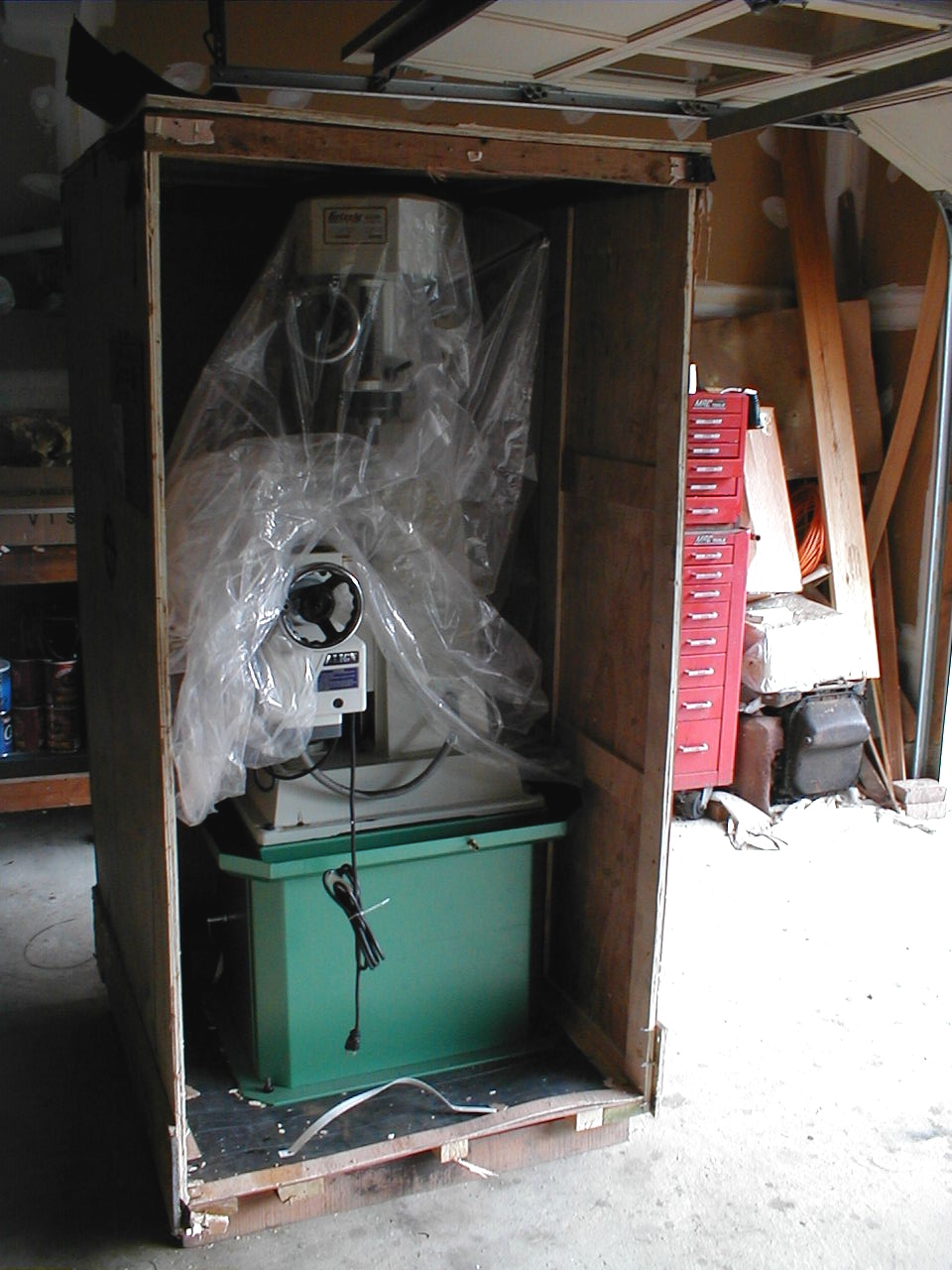
it did arrive on Thursday. One Grizzly G3103 knee mill. The mill is a Chinese made piece that appears
to
be a clone of the Clausing 8520/8530 series and is one of the nicer
Chinese examples of this style of mill.
The crated G3103 is about 950
pounds shipping weight, but you can drop about 100 pounds for the
crate. As industrial mills go, this is a light-weight. As a
mill for the hobby machinist, it is pretty substantial. I will be
stripping the mill down to pieces in order to move it into my
walk-out basement. It is just too heavy to move as a single piece
into the basement. It will also allow me to clean all of the oil
and gunk that somewhat protected it from rusting on its journey from
China to Virginia. I will also be making sure that everything is
set up correctly so that it will be as accurate as possible.
I have been wanting to get a mill for
years, no, decades, but something else always seemed to come up that I
needed more. When I finally decided to make the purchase, I spent about
2 months of non-stop milling machine research before I finally spent
the dollars on the G3103.
I started out with the intention
of buying a used Bridgeport "J" head, Clausing, or any the better known
American/ import standards. However, as I seriously began to look, the
former mechanic and sometimes machinist side of me took over. As
a
former Mazda mechanic, I knew those cars as well as most Mazda
mechanics
up until the time I stopped working on them every day. After that
time, I can say I generally know the cars, but I wouldn't call myself a
Mazda mechanic anymore. For a while I specialized in other
imports, but never knew them as well as the guy who spent 5 or 6 days a
week living and breathing that brand. So I started thinking about
mills in the same context. What did I know about mills? I
figured that this probably summed it up well: "I know enough to
not fool myself into thinking that I could choose an old mill and not
wind up with junk." Or maybe I don't know enough to choose a mill
that would "just" take me many moons to get decent accuracy out of.
Yes, I could get lucky and find one
that was 20 years old, but not used much. If you read the
bulletin boards at the Home Shop Machinist and a half dozen other sites
where machinists hang out, you'll find that there's always someone who
just got an incredible deal on a "barely used" 25 year old piece of
industrial equipment, but after watching Ebay for the last 2 months,
I'd
have to say that the norm is more like "well used," than "barely used"
for the older Bridgeports. The "barely used" - or even "well
cared
for"industrial mills in the price range that I allowed myself,
(around$2200), do exist, but you'd need to know your mills well to
find them.
Another challenge with the "old iron",
is the price of shipping. The Grizzly would cost me about $160 to
get it from Pennsylvania to Virginia, and another $75 to get the
shipping company to bring a lift gate and pallet truck (pallet mover)
in
order to be able to lower the crate from the tractor trailer to the
street and then from the street to the garage. I'm told that
Grizzly gets a favorable rate because of the volume of shipping that
they do. On the other hand, since the Bridgeports are about twice
the weight of the Grizzly, the shipping is substantially more.
You
also usually get hit with a crating charge of $100 to $300, so if the
mill you purchased on Ebay turns out to be less than what you thought
it
would be and you can actually return it for a refund, you are going to
be out a substantial amount in shipping and handling. Perhaps if
I
lived in an industrial center where there were more mills (or for that
matter- ANY mills) listed in the want ads and I could visit each one
and check it over, I might have been able to find a good used piece.
Anyway, enough of why I didn't go with a used mill. When I
decided
to go with a new mill, there were a few that were in the running and a
few that I read about that I never seriously considered. First to
get thrown out of contention were the round column "mill/drills."
On the plus side, they usually have a pretty fair amount of Z axis
travel (up and down movement). However, because of the round
column, when you change tools - like when starting with a small
diameter
(and length) drill bit and progressively going to larger and larger
sizes, the head must be moved - and the round column makes it hard to
get back to the exact location that you started in. There are a
couple of alternatives that avoid this problem. One, getting a
mill/drill with a rectangular column,which allows you to keep the head
from moving. Two, getting a mill with a "knee." The knee
allows the table to move up and down and the head doesn't have to move
at all. You can move the head up and down a few inches (depending
on the model), but it is usually more accurate to move the knee.
The next type of mill that I had to pass on was the combination mill
and lathe. While I do want a lathe, the combination mill and
lathe
in the lower price ranges just don't have the accuracy that
I wanted. It is possible to get a combination mill and lathe
with good accuracy, but the ones with the great specs start at about 5
times the price I wanted to pay.
Of the mills I didn't consider were
the small table models, like the Sherline and Taig. These are
pretty neat little mills if you are working with small parts, but I
wanted to be able to work with larger stock. If everything else
is
equal, the mill with more mass will do the better job as there is less
flex.
So I finally got to the point that I had chosen a general style of
mill- a knee mill, and the size - 6" by 26" - which is the
table size. I decided on a Chinese mill because right now it is
the best "bang for the buck." Which narrowed it down to the
Grizzly G3102 or G3103, the same mills by Harbor Freight, or the 3004-0095
from Wholesale Tools. I think that I read pretty much everything
on the net regarding all of these mills, including a pretty helpful
Yahoo group called 6X26 milling machines. I happen to have a
Harbor Freight fairly close to my house and took a drive out there with
hopes of seeing their model, but they only had a couple
mill/drills. The quality of the two mills I saw were pretty
bad. The geared version of the rectangular column mill/drill was
sitting in a puddle of oil from the gearbox and there was so much sand
under the paint that it looked like they had sprayed it in a
sandstorm. Whoever had uncrated it hadn't bothered to wipe it
down
to remove the oil to keep it from rusting in transit from China, but
under the oil was rust! I can't explain that one.
I spent some time trying to decide between the Wholesale Tools
version and the Grizzly. The WT is less expensive, but the
Grizzly
had great reviews of their customer service. In the end, I
decided
to spend the extra money for the Grizzly. and I now have the mill!
That's pretty good. I have condensed a couple months of
studying,searching for information, and learning into a few
paragraphs. Suffice it to say that I now feel that I am not a
complete rank amateur/ newbie. I am a more knowledgeable rank
amateur / newbie! However, this will change a little more for the
better as I strip and reassemble the mill in order to move it to the
basement workshop. I have been through the process a few times in
my mind and have a stack of notes from articles I have read on things
to
look for, things to double-check, and a lot of notes on how to scrape
the ways.
Next up, stripping the mill down so I can move it.
Coming
soon!
The
new mill is on its way... more to come.